The global appetite for K-beauty tourism isn’t slowing down. In fact, industry data show it’s accelerating — and not just in Asia. According to the Ministry of Health and Welfare, about 1.17 million foreign patients visited South Korea last year, nearly double the previous year’s figure. Of those visits, roughly 68% were concentrated in dermatology and plastic surgery clinics, underlining how medical tourism in Korea has become a dominant travel motive.
At the same time, Korea Customs Service statistics reveal that K-beauty exports surpassed $10 billion for the first time. In Q3 alone, exports reached $3 billion — a 17.6% year-on-year increase. The numbers are clear. The demand isn’t isolated. It’s structural.
Professor Choi Chul of Sookmyung Women’s University assessed the situation directly:
“K-Beauty has become a core consumption content for travelers because the cosmetics, medical procedures, and skincare industries all possess world-class quality and price competitiveness. As K-Culture gains remarkable popularity, overall tourism demand is likely to continue increasing.”
Viral “Korea Glow Up” Drives Surge
The trend is widely fueled by the viral “Korea Glow Up” challenge circulating on platforms such as TikTok. Before-and-after transformation videos featuring international visitors are drawing high engagement. The search terms “Korea skin treatment trip,” “Gangnam Botox clinic,” and “Olive Young shopping haul” are now trending globally.
According to a report by Maeil Business Newspaper, so-called “beauty tourists” are increasingly structuring entire itineraries around dermatological procedures, cosmetic injections, skincare treatments, and Korean cosmetics shopping.
A Week, A Glow-Up — And Millions of Won
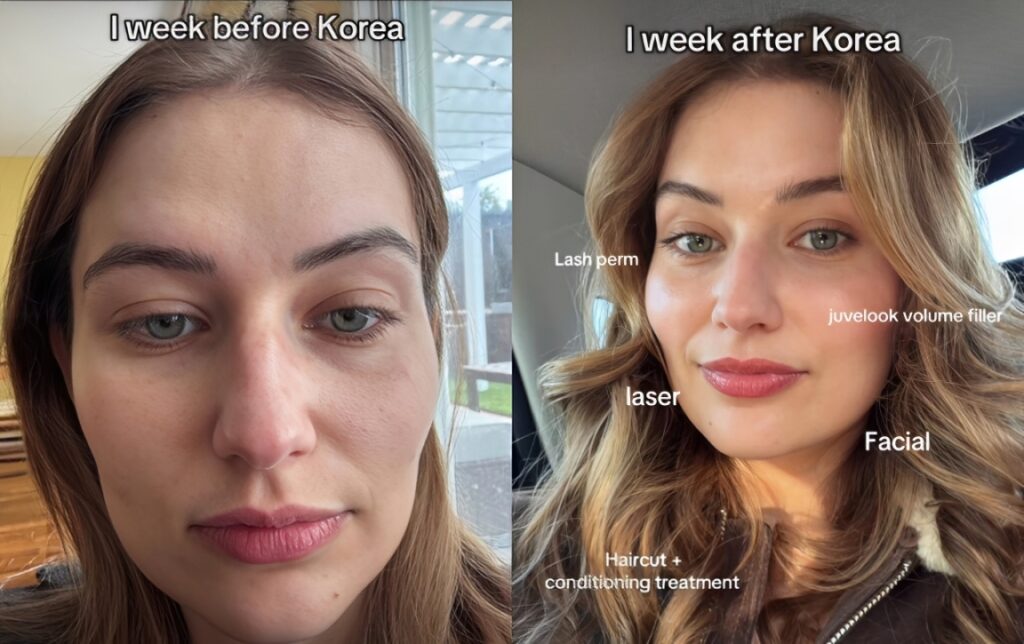
Iris (31), an Icelander who traveled to Korea last January, designed her five-day stay around beauty services. The theme was simple: transformation. During her visit, she underwent eyelash extensions, skincare sessions, personal color analysis, makeup lessons, a profile photoshoot, and Botox injections.
“I think I visited every Olive Young store in Gangnam, Myeong-dong, and Hongdae,” she said.
“I’m bringing back Olive Young cosmetics that my friends requested as souvenirs.”
She spent approximately 4.8 million KRW (around $3,400), allocating most of the budget to medical procedures and cosmetics. It was, by her account, money well spent.
Short Trips, Focused Treatments
For many visitors, the stays are brief. Efficient. Targeted.
Kimberly (28), a Chinese national, came for a four-day skin-focused trip.
“I researched how to book hospital appointments in advance back in China,” she noted.
“Many of my friends come to Korea for just one or two nights specifically for Botox or skin procedures.”
Clinics in Gangnam have adapted quickly. Interpretation services are now standard.
Mr. Je (33), a consultant at a major plastic surgery clinic, explained:
“We have coordinators capable of speaking English, Vietnamese, Chinese, and Japanese.”
A nearby nail salon employee added:
“Customers from the U.S. and Europe are our main clients. While we use translation apps, basic English communication is essential.”
From Jakarta to Moscow — The Expansion
The “K-Beauty Tour” trend has moved well beyond East and Southeast Asia. It’s now drawing travelers from Europe and North America.
Victoria (24), from Russia, shared:
“I revisited Korea to spend a week going to nail salons, hair salons, and dermatology clinics.”
Meanwhile, Cyndia, a beauty shop owner in Jakarta, highlighted cost efficiency:
“Botox in Jakarta is more than twice as expensive as in Korea, so it’s more economical to get treated here.”
“Korean cosmetics are very popular back home, so I sweep up new products every time I visit.”
Price competitiveness plays a central role. For example, Anua Hyaluronic Acid Cream (60ml) sells for 28,900 KRW at Olive Young, while a smaller 30ml version costs 34,600 KRW on Amazon. Similarly, R-brand’s Vegan Lip Balm is priced at approximately 13,000 KRW domestically but reaches 19,900 KRW on overseas platforms. The differential is noticeable — and it’s driving purchasing behavior.
Tourism Packages Evolve
Travel agencies are responding. Companies such as Jane DMC Korea now operate structured packages combining skin treatments, personal color analysis, and cosmetic shopping tours.
A company representative stated:
“Inquiries from foreign tourists are steadily increasing.”